
Extrait gratuit
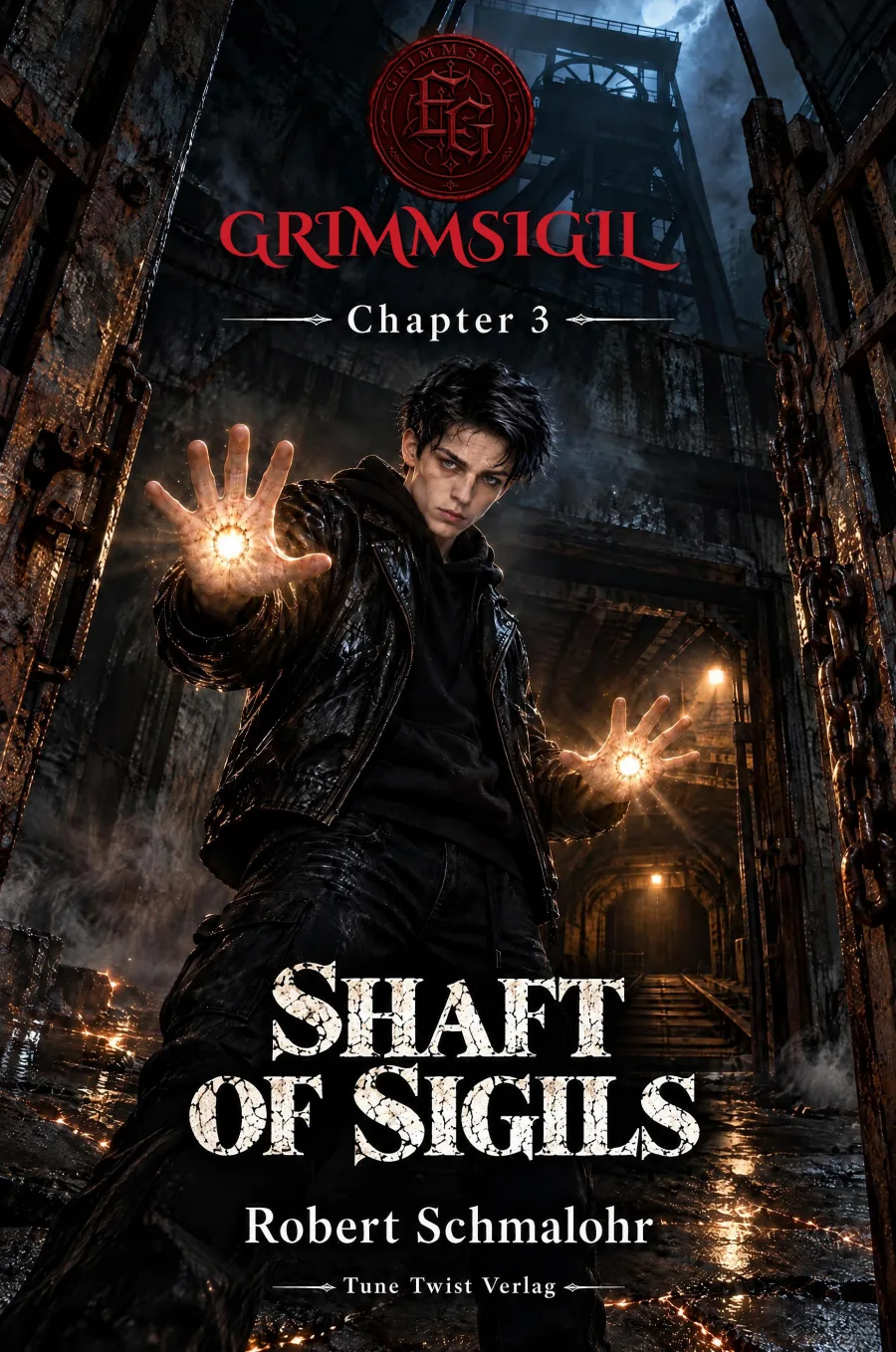
Numéro 3 · Shaft of Sigils
Chapter 1The Harbor
The canal lay gray and flat under the sky when Brandt reached the bank just after six. The water shoved itself sluggishly against the sheet piling. The puddles on the quay wall stood so deep that his shoes were soaked before he even reached the warehouse.
The patrol car blocked the entrance, so he walked the last stretch on foot. He turned up the collar of his trench coat. The rain fell at a slant, cold, and found its way through the fabric at his neck right away.
"You look like a man who hasn’t slept," Suko said. He stood in the open warehouse door, an umbrella in his hand that was too small for two men.
"Twenty years, Suko. Twenty years you’ve known me now, and every damn time with that line." Brandt shook out his collar, water dripping onto the cobblestones. "At some point you’ll have to come up with something new."
"At some point you’ll actually look rested. Then I’ll think of something."
"I didn’t sleep." Brandt stopped on the threshold. The warehouse smelled of wet wood and diesel. Underneath that lay something sharp that crawled into his throat.
On Friday he hadn’t gotten any farther than the police tape. He’d left the interview at headquarters hanging and waited two hours in the wind while the fire department sprayed a roof that only got hotter underneath. They’d fought it until evening, and then the structural engineer hadn’t let anyone back inside. Breuer’s line about somebody lying in there had stayed just a line for two days. During the night the warehouse had flared up again. Today he was allowed in.
Half the warehouse was black. Charred pallets were stacked up to the roof, corrugated metal hanging in shreds from the beams. The other half was almost untouched. A forklift, a row of wire cages, a calendar on the wall still showing February. Brandt looked at it longer than he meant to.
Brandt stepped deeper into the warehouse and let his eyes travel once around the room. Old habit. First the frame, then the picture inside it. On the back wall, shelf boards hung crooked in their brackets, the anchors half torn out of the wall. The concrete had split open in several places, fine cracks branching like veins.
Then he saw the man.
He lay on the concrete between two overturned pallets, arms spread wide, like he’d fallen backward. The shirt was torn open. The chest was open, and it didn’t look like a knife. After twenty-five years on the job, Brandt knew that on the spot. The edges of the wound were black and frayed, eaten away from the inside out. Underneath, in the flesh, lay a glow, faint and yellowish, like the light of a candle someone had pushed under the skin.
Above the chest, a hole gaped in the roof. A drop fell, hit the wound, traced a line through the glow, and ran across the ribs into the concrete. Suko had seen it too. He stepped closer, tilted the umbrella over the body, and caught the water on the fabric. Forensics needed a dry picture.
"The roof," Suko said quietly. "There’s been a hole up there since Friday. The rain’s falling right on him."
Brandt dropped into a crouch. His right knee screamed, a hot wire pulling all the way up into his hip. He clenched his teeth and stayed down, eyes fixed on the chest.
Eight years now since the job where the blade had gotten him, and the knee had never forgiven him for it. In wet weather it reported in more reliably than any weather forecast. He pressed his flat hand against his thigh and forced the leg to hold still.
He forced himself to look closer, even as his stomach turned. The skin around the wound had bulged, pushed outward, before it tore open. No cut. No gunshot. Something that had scorched the ribs from the inside, like paper held over a flame.
"Did the officer see the light?"
"He threw up," Suko said. "So he saw it."
"Which one?"
"Breuer. The kid. He insisted on going in first, because he was right on Friday. Now he’s standing behind the car, doesn’t want to come back in." Suko nodded his chin toward the street. "Can’t say I blame him."
Brandt glanced over at the street. A young patrol officer stood leaning against the car, arms crossed over his chest, staring fixedly at the asphalt. Brandt knew that look, the look of a man who’s just realized the job asks more of him than anything he learned in training.
"When did it start up again?"
"Around midnight. The night watchman from the neighboring lot noticed the glow and called the fire department. They got here fast. But only half the warehouse burned again, the same half as on Friday. Looked like somebody set only half of it on fire, on purpose." Suko spoke quietly, like he was in church, and held the umbrella steady over the body.
Brandt let his gaze travel over the floor. A fire hose lay stretched across the warehouse like a dead snake. Black stains stuck to the concrete that hadn’t come from the water used to put out the fire. He counted three, then four, then stopped counting.
Brandt didn’t straighten up yet, staying crouched and letting his gaze travel over the dead man’s arms. No defensive wounds, no scratches under the fingernails, nothing that pointed to a struggle. The man hadn’t even raised his hands.
"Name?"
"Dennis Lenz. Thirty-four. Warehouse worker for the shipping company on the canal." Suko pulled a plastic bag from his jacket pocket and held it up. Inside was an ID card. "It was in his shoe. Left one. The officer showed it to me before he puked."
"In the shoe."
"Whoever carries their ID in their shoe is scared of pickpockets." Suko gave a crooked grin, no joy in it. "Or he didn’t want anyone knowing right away who he was."
Brandt didn’t take the bag. He looked at the photo shining through the plastic. A smooth face, short-cropped hair, a smile that didn’t reach the eyes. Then he looked back at the chest.
Thirty-four. An age where you’re still making plans, not starting over. Brandt thought briefly of Marie, sixteen, and how far thirty-four was from her, and how short the distance still was, considering how fast his own years had gone.
The glow seemed to pulse. He wasn’t sure if it was just the warehouse lights catching in the wound’s edges, or if the wound got brighter the moment he looked at it.
Look first, think later. Not the other way around.
He straightened up. The knee gave, and he braced himself against the forklift’s arm. The metal was cold. A film of soot stayed on his palm. He wiped it on his pants and noticed his fingers were shaking.
The smell came back. Sulfur, not the musty stink of fire damage from burned-out apartments. This one was sharper, almost clean, like a match just blown out. Underneath it lay something sweetish, like burned hair.
He’d seen enough fire scenes in twenty-five years on the job to tell the smells apart the way other people told wines apart. Gasoline smelled different from lighter fluid, burned wood different from burned plastic. This didn’t fit any of the drawers he’d built up over the years, and that unsettled him more than the wound itself.
He walked back to the door. There he breathed through his nose until the air coming in was from outside, damp and smelling of the canal. The smoke kept scratching at his throat. A bitter film stayed on his tongue.
"You leaving?" Suko asked.
"I don’t want to be in that warehouse any longer than I have to." He lifted his foot and looked at the sole. Black tracks, ash, fine dust. "And I don’t want the officer throwing up again while I’m standing next to him."
He knocked his shoe against the doorframe. The dust stayed where it was. It sat stuck in the tread, black and grainy, like it refused to let go.
"That wasn’t the whole reason."
"No."
Suko said nothing more. He kept holding the umbrella over the dead man until the forensics tech came back with the camera and made room for him.
"Get me a copy of the report once the doc’s done," Brandt said over his shoulder. "And tell Breuer to sit down. The kid looks like he’s about to pass out."
"Will do."
Brandt walked back to the car over the wet cobblestones. The knee pulled with every step. Each time, the man’s chest came back to him, the glow inside it. At the car he stopped and dug the key out of his coat pocket. Above the canal, the water lay dark and still.
Who does something like this. And why exactly half.
He unlocked the car and sat down without closing the door right away.
***
It was colder inside the car than outside. Brandt turned the ignition key one notch, until the blower gave off nothing but a thin rush of air. No warm air came. He shut the engine off again.
The windows fogged up from the inside. He wiped a clear strip with his sleeve and looked through the glass at the warehouse. The door stood open. Suko had folded the umbrella by now and leaned it against the frame.
The file lay on the passenger seat. Brandt picked it up and set it on the steering wheel. The cover had gone damp at the edges. He opened it.
His fingers were stiff from the cold, and the staple only gave on the second try. On the dashboard still sat yesterday’s pack of mint candies, half empty. He pushed it further left, out of sight.
The night watchman’s name was Olaf Dreyer. His statement ran two pages, typed tight. Brandt read it twice.
Around quarter to midnight I looked out the kitchen window. The warehouse door stood open. A woman came out, wearing a hood. She didn’t go toward the street. She went toward the canal.
Brandt read the sentence again. The pen sat between his fingers, and only now did he notice he’d been gripping it. He turned it with his thumb, once, twice, until the tip clicked.
Dreyer hadn’t written anything about a face. He hadn’t given a height, only that the woman had been slender. She had moved like she was gliding. The word was underlined. Someone had gone over it a second time later, the line twice as thick as the rest of the sentence.
Brandt knew nothing about Dreyer as a person, but he’d had the type in front of him plenty of times before. A man who looked out the window at night out of habit because he’d slept badly for years, and who the next morning tripped over every detail he’d told the officer, wondering if he’d just imagined the movement because it fit so well with what he believed he’d seen.
Further down it said Dreyer hadn’t noticed the fire’s glow until half an hour later. Until then the warehouse had been dark. No flames, no smoke. Brandt tapped the pen against the line and read it a third time.
His right knee pulled. He stretched the leg out under the steering wheel and hit the pedals. The cold was everywhere now, in the fabric of his pants, in the leather of the seat, in his fingertips. His breath stood as a thin mist in front of his mouth.
He tore a sheet from the notepad between the file and the gearshift. On the back of a receipt he wrote the name in block letters. ELIAS GRIMM. Underneath he wrote the word Bismarck and underlined it twice.
The receipt was from the gas station on Ringstraße, two weeks old, the print already faded. He turned it once in his hand, then wrote down only what he knew, not what he suspected.
Bismarck. The courtyard. He stood next to the dead man like he’d been invited.
He looked at the note. A name on a receipt wasn’t an accusation, and a woman in a hood by the canal wasn’t a murder weapon. Still the thought stayed, small, and he held it in his mouth like a lozenge he didn’t want to bite down on. Brandt pushed his thumb under the nail and found nothing, just the spot where the pressure sat.
His hand wandered to his coat pocket, to the mint tin, and stayed there. He wanted a lozenge, his tongue wanted the sharp taste that covered up the smoke in his throat. He left the tin where it was. The sulfur smell still hung in his collar and his hair, and he didn’t want to let mint wash it away.
Three years now since the cigarettes, and the lozenges had stayed on as the replacement he’d never quite gotten rid of. Astrid had once told him he sucked on those things the way other men swallowed down their worries.
Through the windshield he saw Suko gesturing something to the forensics tech, his hand stretched out wide. Behind him lay the canal’s water, dark and without movement. Suko’s shadow fell almost to the edge of the bank.
Brandt laid the note in the file, the name face up, and closed the cover. The damp had softened the cardboard. He pressed his palms against the file until the cardboard cover gave under the pressure.
***
It rang four times. Brandt counted along, because besides the phone and the note on the passenger seat he had nothing else to hold onto. On the fifth ring something clicked on the line, then breathing.
"Yeah."
Elias’s voice sounded thick and slow, like he’d just been pulled out of bed. In the background something clicked, steady and fast, like a keyboard that never gets put down.
"Brandt."
Silence followed. Brandt kept hearing the clicking, then it cut off, like a key let go.
"I know," Elias said.
Brandt looked through the windshield. Suko stood next to the forensics tech, talking with his hands, the umbrella tucked under his arm now. The canal lay behind them, without movement. Brandt pulled the file a little closer, until the note with the name showed. He laid his hand on it, flat, like on a report not yet signed.
"You’re awake," he said.
"I’ve been awake since you called." A rustle, fabric against skin. "You call early."
"It’s almost seven. That’s not early for you."
"Where are you right now?" Elias asked.
"At the canal. Where the man’s lying."
Elias didn’t answer. Brandt waited. He knew his limit with silence, the point before the line turned into nothing but quiet, and he didn’t want to test it here. He tapped the pen against the edge of the notepad, twice. Then laid it across the file.
"You’re coming to the station Wednesday," he said. "Ten o’clock. Ebertstraße. Ask the front desk for me, not for a colleague."
"About what?"
"About a find at the harbor."
"What kind of find?"
"We’ll talk about it Wednesday."
Something rustled on the other end. A door fell shut, then it went quiet again. Brandt pictured where Elias might be standing, maybe at the window of the apartment in Erle, maybe in the kitchen. He had no idea. He only had the voice, and it sounded like too little sleep and something he didn’t want to name.
The clock on the dashboard read just before seven, the numbers yellow and flat. The windshield kept fogging up from the inside. He wiped the back of his hand across it and saw his knuckles, red from the cold. The knee pulled as he shifted his foot under the wheel. He stretched the leg out further, until the pain ran into his hip, then pulled it back in.
"You sound like you already know something," Elias said.
Brandt registered the question. Elias hadn’t asked who the dead man was. He’d asked about the find. Brandt noted it in his head and let the question sit there, unanswered.
"I know you stood next to a dead man in Bismarck," Brandt said. "And that you didn’t tell me everything on Friday."
"I never said I tell everything."
"No. You didn’t."
Brandt heard Elias exhale. It didn’t sound angry. It sounded like a head leaning against a wall, hoping it would give.
"And don’t come alone," Brandt said.
"Who’s supposed to come with me? My lawyer?"
"If you have one, bring him. If not, bring someone you trust." Brandt pressed his hand harder on the file. The cover gave softly under his fingers. "Someone who can say afterward how you came out of the room."
"Is that a threat?"
"That’s advice." The cardboard gave under his palm. "I don’t give it often."
In the background the clicking started up again. Brandt thought he heard a second voice, higher, urgent and impatient. He couldn’t make out words. Elias said something, half under his breath, to someone who wasn’t on the phone. The other voice answered with a single word. It sounded clipped.
"Levi," Elias said, not to Brandt. Then louder: "I’m on the phone."
Young men at their computers in other apartments, questions they never asked out loud. He pushed the thought away, because there was nothing he could prove from it.
"So," he said. "Wednesday, ten o’clock."
Elias stayed quiet. Brandt heard him breathing, once, twice, slow. He thought of the man in the warehouse, of the chest and the glow inside it.
"I’ll be there," Elias said.
Brandt took the phone from his ear. The display showed the seconds of the call in white digits, below it the number he knew by heart without ever having saved it. He didn’t hang up right away. Only when he swiped his thumb across the display did it go dark.
Then he reached into his coat pocket and found the mint tin. It was cold and light. He flipped it open and took a lozenge he didn’t even want. The sharp taste kicked in, too sharp, and he felt it all the way behind his eyes. The sulfur from the warehouse still hung in his coat collar and his hair all the same.
Brandt pushed the lozenge from one cheek to the other. His stomach clenched, empty and sour from coffee on an empty stomach. And yet he’d only had one cup since last night, and it sat cold in the holder. He reached for it, held it a moment in his hand, and set it back down.
Outside, a patrol car rolled slowly past the warehouse, water splashing up under the tires. Suko lifted his head and looked over at the car. Brandt raised his hand, only halfway. Suko nodded, turned, and waved the forensics tech back into the warehouse, the umbrella still under his arm.
Brandt closed the file. The note slipped under the cover, and he pressed it back up with his flat hand. Then he opened the door. The cold pushed in, damp and smelling of the canal. He got out without taking the key out of the ignition. On the cobblestones the puddles stood all the way to the quay wall, and his knee was already back.
He stood a moment by the car and looked up at the sky, which barely differed from the warehouse wall: gray on gray, without a single spot where the sun could even be guessed at. Wednesday, he thought. Three days until then, and he’d need every minute of it to figure out what he actually wanted to ask the young man on the phone.
Et ensuite ?
C'était le chapitre 1. Le numéro complet est disponible en e-book (EPUB), prêt à télécharger juste après l'achat, pour Kobo, Tolino, Apple Books, les téléphones et Kindle.
Grimmsigil Post
Préviens-moi quand le prochain numéro sort
Un court e-mail par nouveau numéro, rien d'autre. Gratuit, désinscription à tout moment.